


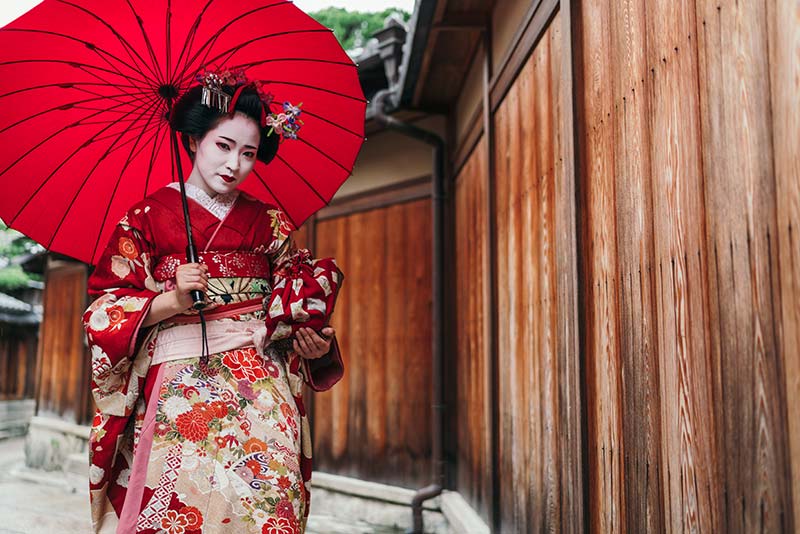
Geisha. The name itself invokes ones imagination of a Japanese woman trained solely to entertain men and fulfill their wildest fantasies. But is there truth to this notion? Let’s take a deeper look and discover the real meaning of geisha.
First of all, the word geisha literally means “one trained in arts;” gei means “art” and sha means “person.” Geisha are, in fact, females trained in the traditional arts of Japan, like dancing, singing, poetry, calligraphy, and many others. These women actually underwent extensive training to become the best in their trade. Because of the calibre of their performances and the intricacy of their attire, people around the world do come to watch them perform.
There are 2 major types of geisha. Those that perform traditional Japanese dance are called tachikata; while those that sing or play musical instruments are called jikata.
There are places in Japan that are termed as geisha districts (“hanamachi”/”kagai”). Some areas famous for its geisha are Atami city and Asakusa. It is in these places that geisha receive their training; it is also where some of them reside. Banquet houses, called ochaya, are established in these geisha districts. The rooms in these houses can be rented and it is here where the geisha entertain their guests.
Interestingly, geisha were born out of the need for some women to make a living during the early years of Japan. Because of feuds within the country, women whose families lost their wealth and status were forced to find other means of living. These women, especially those who were highly educated, resorted to entertaining at high-class parties. Others, however, also engaged in prostitution. At that time, it was acceptable for Japanese men to look for sexual satisfaction from women who were not necessarily their wives. Pleasure houses were established during the 16th century for this reason alone, which was considered legal. It is in these pleasure houses that men were entertained by what was called “play women” or courtesans. Some of these women not only offered sex, but also charmed their clients with talents like dancing and singing. As Japan progressed as a country, so did the people’s fascination for beauty grew. Pleasure houses were glamorized since they had women who offered both beauty and talent. More importantly, some of these women began to specialize in their talents and developed a new profession – one of pure entertainment. Near the end of the 17th century, the first geisha appeared in pleasure houses.
However, what was more interesting was that the first geisha were actually male! They provided the first part of the entertainment, after which, the most gifted courtesans appeared and performed. Eventually, female geisha began to exist strictly offering their talents in entertainment. During World War II in 1944, however, the geisha trade declined as the women had to work in factories to make their contribution for Japan. Instead, prostitutes who offered their services to American soldiers began calling themselves as geisha girls. This tainted the image of the geisha and this was why westerners and other non-Japanese associate them to prostitutes. After a short period, some women returned to their previous profession as geisha. They fought to maintain the true image of geisha.
A geisha undergoes several stages of training before she earns the right to be called full-fledged geisha.
The first stage is called shikomi. At this stage, a girl is required to work as a maid and assist a geisha in dressing up. At the same time, she goes to geisha school to learn about Japanese traditions and the arts and also get acquainted with the geisha lifestyle. Once she becomes skilled in the arts, she undergoes a final and difficult dance test. After which, she enters the second stage called minarai. This stage lasts for about a month or so and it is in this stage that she accompanies a geisha, her onee-san (“older sister”) to banquets. Here she learns certain skills that are not taught in geisha school, yet are very useful to being a professional geisha. These are skills in conversing and gaming. She wears a more elaborate kimono than the onee-san, indicating her stage of training. She also gets to earn a third of what the geisha is paid, and scout for potential clients. The third stage and the longest of all, which could take years, is called maiko. Maiko, meaning “dance girl,” is the stage wherein a girl enters geisha apprenticeship and establishes a crucial older sister-younger sister relationship with her geisha mentor.
She accompanies her geisha mentor to every single engagement, learning more such as the proper way of serving tea, playing musical instruments, successfully carrying out conversations, and dealing with different personalities. At this stage, and with the help of her mentor, she also picks her new professional name with its equivalent symbol (kanji). She also builds her reputation, earning recognition in many teahouses and such. Once a girl is ready, she enters the last stage and is finally called geisha. Here, she receives the full charge for her services.
Geisha may appear to be demure and submissive. In reality, geisha are independent, emotionally strong, and wealthy women. As hostess, they charm and flirt with their clients yet effectively take control of everything. To be geisha means to remain single; still they can choose to have a relationship with any man they want. Throughout their profession, they make sure to maintain a good reputation, too. They also train hard each day and strive to perfect their skills. From the first time they emerged decades ago, geisha were, and still are, self-sufficient Japanese women who choose to take complete control of their lives. A geisha does personify female beauty, grace, and strength.