


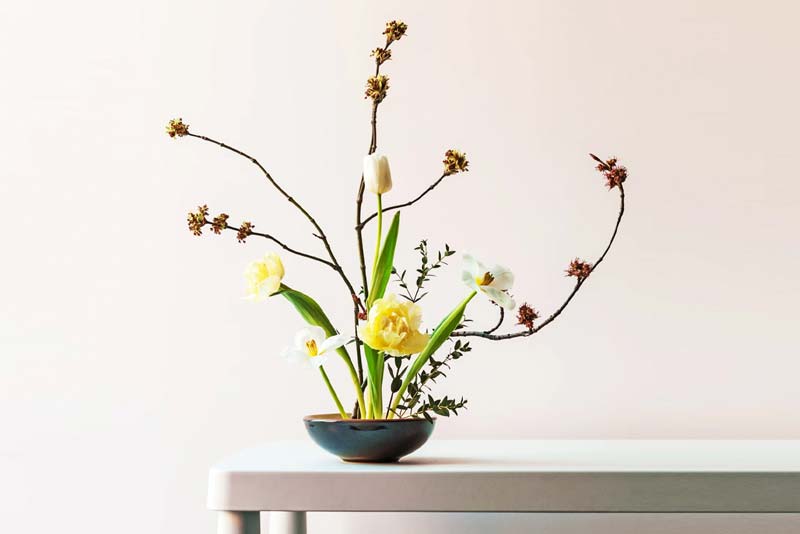
Ikebana is a form of flower arrangement in Japan but is more complex compared to other styles used from other cultures. Ikebana designs are undeniably breathtaking and inspiring, which keep Japan within international radar.
Ikebana translates as “giving life to flowers,” or “flowers kept alive.” Indeed, when one is able to behold an ikebana, one will become amazed at its construction and the techniques that were utilized. As a form of disciplined art, ikebana is an expression of humanity and nature in complete harmony.
But ikebana is not just a collection of carefully arranged flowers in a vase. Other parts of a plant, such as stems and leaves, are also used. This is done so that the shape, form, and line of an arrangement are highlighted and the intention for which it was created will be appreciated by the observer.
Ikebana has 2 important facets. One of which is the aspect of minimalism. This means that only a few flowers may be used and they should be artfully integrated into the arrangement. Another facet of ikebana and considered most important above all is spiritual. The practice of ikebana is supposed to invoke appreciation for nature. For this to happen there must be complete silence when a practitioner is designing an ikebana. Furthermore, it is believed that a feeling of closeness to nature calms one’s entire being.
Ikebana was introduced to Japan centuries ago through Buddhism. People honoured Buddha by offering him flowers. Initially, Buddhist priests were the only ones who practiced and taught ikebana. Later on, however, other schools surfaced and began teaching ikebana and introducing new styles. Eventually, the art became an inherent part of Japanese custom.
There are 2 types of ikebana. The first is heika which is the basic style of ikebana. Heika was developed centuries before and follows several rules. It uses a tall vase with a narrow opening, and emphasis is placed on vertical lines. The second type is moribana, which was developed only a hundred years ago and has a few rules. It uses a shallow, wide vase with many sharp points into which flowers are inserted. Its arrangement is spread out horizontally. Heika and moribana all contain 3 key elements – heaven, man, and earth.
Indeed ikebana is like a glimpse of heaven recreated by man to inspire and give hope for all humanity here on earth!